Showing posts with label Value Proposition. Show all posts

Friday, 5 August 2016

Exploratory Research Design


In the context of marketing research, every research problem is unique in its own way, but almost all research problems and objectives can be matched to one of three types of research designs—exploratory, descriptive, or causal. The researcher’s choice of design depends on available information such as nature of the problem, scope of the problem, objectives, and known information. Exploratory research design is chosen to gain background information and to define the terms of the research problem. This is used to clarify research problems and hypotheses and to establish research priorities. A hypothesis is a statement based on limited evidence which can be proved or disproved and leads to further investigation. It helps organizations to formulate their problems clearly.
Exploratory research design is conducted for a research problem when the researcher has no past data or only a few studies for reference. Sometimes this research is informal and unstructured. It serves as a tool for initial research that provides a hypothetical or theoretical idea of the research problem. It will not offer concrete solutions for the research problem. This research is conducted in order to determine the nature of the problem and helps the researcher to develop a better understanding of the problem. Exploratory research is flexible and provides the initial groundwork for future research. Exploratory research requires the researcher to investigate different sources such as published secondary data, data from other surveys, observation of research items, and opinions about a company, product, or service.
Example of Exploratory Research Design:
Freshbite is a one and half year old e-commerce start-up company delivering fresh foods as per the order to customer’s doorstep through its delivery partners. The company operates in multiple cities. Since its inception, the company achieved a high sales growth rate. However, after completion of the first year, the sales started declining at brisk rate. Due to lack of historical data, the sales director was confused about the reasons for this decline in sales. He prefer to appoint a marketing research consultant to conduct an exploratory research study in order to discern the possible reasons rather than making assumptions. The prime objective of this research was not to figure out a solution to the declining sales problem, but rather to identify the possible reasons, such as poor quality of products and services, competition, or ineffective marketing, and to better understand the factors affecting sales. Once these potential causes are identified, the strength of each reason can be tested using causal research.
For more interesting articles about Sales and Marketing, visit - www.SMstudy.com/articles

Thursday, 4 August 2016

The Return of Email Marketing


By mid-2014 media trackers noted an interesting trend in news consumption. After years of floundering and grasping for innovative ways to engage readers, news outlets such as The New York Times, Bloomberg News and others were seeing their greatest success with email newsletters. Despite all the technologically-enthused punditry to the contrary, old school email emerged as the best method for news delivery.
In a New York Times article from the same year, David Carr reported that news outlets had discovered that their greatest chance of getting “eyeballs” was in the inbox.
This may come as a shock given the newer options (including all the various aspects of social media) out there in the media landscape. It would’ve seemed logical that as new channels for dissemination opened up, there would be a permanent migration away from email marketing, but that has proved to not be the case.
As Carr points out, “newsletters are clicking because readers have grown tired of the endless stream of information on the Internet, and having something finite and recognizable show up in your inbox can impose order on all that chaos.” 
As we embark on 2016, email is officially re-emerging as one of the best tools in today’s marketing toolbox as well. This time not because it’s the default (like it was in the 1990s/ early 2000s), but because email possesses some real advantages over its flashier social media cousins.
In fact, as early as the second quarter of 2013, the Custora E-Commerce Customer Acquisition Snapshot was reporting a four-fold increase in customer acquisition via email over the prior four years. In fact, acquisition through email had grown more quickly than acquisition through social media, despite an increase in social media marketing during the same timeframe.
Three years in and we’re still seeing a customer preference for email marketing. So what are the advantages of email marketing and why has it become the “channel of choice” for many consumers?
A few key factors seem to be the main drivers of the “back-to-email” trend.
One important factor was the advent of the mobile email apps. Gmail and other email mobile apps have opened up the email experience to the mobile user in a way not previously possible.
In addition, the rise in smartphone use has contributed to the ease with which people can check their emails. One third of American consumers reportedly check their email “throughout the day,” and the average person is looking through their inbox 150 times a day, according to an August 2015 Business Insider report.
The article states, “now users are able and prompted to check email on the go, and their attention is no longer divided by a multitude of emails in an inbox checked a few times per day – this means they can pay more attention to each message as it comes through.”
Another important development in email is personalization. The ability to personalize an email has proven to be appealing to recipients. Email marketing platforms such as Constant Contact and Mailchimp allow for user-friendly, one-step personalization.
Author Anne Muehlenhaup notes in her article “The Resurgence of Email Marketing” that personalizing email campaigns based on geography is also an important benefit.
“The result is a more intimate outreach to prospective buyers that delivers to them only the information that is most relevant and specific to them,” Muehlenhaup says.
And the last and perhaps most important benefit of email marketing is it allows the sharing of meaningful, relevant content. Marketers can provide quality content and at the same time keep a customer or potential customer informed on company announcements and product updates.
In a piece titled “5 Must-Haves to Revamp Your 2016 Email Strategy”, Natasha D. Smith, senior editor of Digital Marketing News quotes Christopher Lester, VP of sales for Emma  who states, “The overall theme we see happening (in email marketing) this year is relevancy—in other words, what's relevant to the consumer and not to solely the sender of the message. The expectation of the consumer is that it's not just content for content sake.”
And finally, compared to social media marketing which can be challenging to track in regards to click-through rate, page views and conversions. Email marketing provides a clear look at consumer behavior and how retention and conversion can be improved moving forward.
Although the future may prove different, it appears (at least for now) that convenience, personalization and quality content make email marketing a weapon of choice for sales and marketing teams and the vehicle of choice for today’s consumer.
Sources:
“For Email Newsletters, a Death Greatly Exaggerated” David Carr. June 24, 2014 http://www.nytimes.com/2014/06/30/business/media/for-email-a-death-greatly-exaggerated.html?_r=1
Custora Ecommerce Customer Acquisition Snapshot Q213, http://blog.custora.com/custora-content/uploads/downloads/2013/07/Custora_EcommSnapshotQ213.pdf
“People either check email all the time, or barely at all” Matt Rosoff, Aug. 17, 2015  http://www.businessinsider.com/how-often-do-people-check-their-email-2015-8
“The Resurgence of Email Marketing” Anne Muelenhaupt, Sept. 22, 2015  http://blog.act-on.com/2015/09/resurgence-email-marketing/
“5 Must-Haves to Revamp Your 2016 Email Strategy” Natasha D. Smith, Jan. 12, 2016,=. http://www.dmnews.com/email-marketing/5-must-haves-to-revamp-your-2016-email-strategy/article/464405/

Thursday, 28 July 2016

VMEdu Welcomes You to the Post-Capitalism Era


It has been said that we are exiting the post-capitalism era, and we weren’t even aware of it. We can thank this monumental shift to advancements in technology. Many terms have been thrown around in regards to what sort of economy we have ventured into—such as the sharing economy or frictionless economy—but what path are we really following?
In a recent article we discussed what exactly the frictionless economy is. The frictionless economy centers around companies that provide platforms on which suppliers and buyers can do business directly. Uber, Etsy, and Fiver are just a few of the hundreds of companies that have sprung up in the last decade offering people the ability to be a “self-entrepreneur.” 
According to Alex Chriss, vice president and general manager at Intuit, “What we find so exciting about this trend is it’s solving what has traditionally been the number one challenge any entrepreneur or small business owner faces: finding customers. We’ve seen millions of small businesses struggle to find their next customer – and this struggle has set a bar, a hurdle for entrepreneurs to jump over. Technology is lowering this bar.”
But what about the sharing economy? Companies such as Airbnb and City CarShare allows owners to rent out something that they are not using. This has generally been sharing a house, car, or bike, but the only constant in technology is change, so this sharing could expand to new avenues. Each sharing-economy styled company provides users with ratings or reviews, so that trust is built on both sides of the transaction.
So, which economy are we really entering? One thing that we have learned from technology is that there are no limits. So, why would we limit ourselves by believing that we are entering just one sort of new economy? It seems to be that we are entering various economies that will create branches rather than one straight path. VMEdu gives professional trainers and educators the ability to be a part of both the frictionless AND sharing economy, with its Learning Management System (LMS). The VMEdu Authorized Content Partner (V.A.C.P.) program is one of the finest adult learning platforms available. The V.A.C.P. program is for anyone looking to create online adult learning courses for any subject and in any language. 
As a partner, you can create and upload your courses with the user-friendly VMEdu Course Builder. You can also run the courses on your website for free. Course materials can include videos, test questions, flashcards, glossaries, case studies and more. 
Once your courses are uploaded via the VMEdu Course Builder you have the option to sell them to the VMEdu network of more than 750 Authorized Training Partners (V.A.T.P.s) in 50+ countries. Having the support of such a strong network will help you reach a larger number of potential consumers in a shorter amount of time. 
The V.A.C.P platform gives you the ability to sell your own courses, do business directly with customers that have been provided for you, and be your own boss in addition to hosting your courses on your own website to share with your contacts. This program equips you for whichever future economy becomes our reality.
You can find more information on the VMEdu V.A.C.P. program at www.vmedu.com/Benefits-of-VACP.asp 

Wednesday, 27 July 2016

The importance of product positioning to the marketing strategic planning


Product positioning is a very important tool for an effective marketing strategic planning. Product positioning creates an image of the company’s products in the mind of consumers, highlighting the most important benefits that differentiate the product from similar products in the market. Product positioning involves identifying points of parity and points of differentiation that enable a company’s product to both meet market standards while offering consumers additional value on key dimensions such as quality, innovation, price, leadership, and functionality, among others.
Product positioning starts with identifying the specific, niche market segments to target e.g. not just working professionals but single working professionals of age group 25-30 years, having an annual income of $50,000-$60,000, and enjoy adventure activities. After segmenting the target market by demographic and psychographic attributes, marketers must understand customer needs. With well-defined target segments, product positioning enables a company to meet very specific needs of a particular market segment, offering value that may not be provided by competitors.
Marketers must keep an eye on the competitiion while considering positioning elements of their marketing strategy. An effective positioning must convey a message to customers why this company’s product should be preferred over the other competitor’s products of similar nature. In other words, the company should not go by the flow of the market i.e. copying what the competitors are doing rather they need to stand out from the crowd by offering distinguishing or differentiated product attributes and other value added services.
The next stage is how to communicate the differentiated offerings to the identified niche market segments. This is possible by selecting the appropriate communication channels that are tailored to connect with their identified target audience when they will be most receptive to these messages. Say for example, a sports car manufacturer position their products through communication via television advertisements during sports events like formula one. They also use print media by running full page high resolution color ads in sports magazines.
It is important that the business incorporate the product positioning across all facets of the business, including manufacturing and customer service in order to ensure consistency of the positioning from the consumer’s standpoint. Further, the positioning must not only align with other divisions and with the current corporate objectives, but also provide long-term sustainability and remain relevant for product variants and for future market scenarios. Using strong product positioning is a key component to the success of the Marketing Strategy and to meeting overall corporate objectives.
To learn more about the product positioning, visit SMstudy.com.

Wednesday, 20 July 2016

Social Insights on Video Marketing in the Age of YouTube


Down ‘n’ dirty or überposh, there’s a place for all quality of video marketing in the world today.
Recently we noted marketers’ growing acumen at not only parsing available social data, but also using the social media environment to probe the social community and glean consumer preferences and other social insights.  
We said, “Filling the role of the modern-day focus group, social media insights are also valuable for taking the temperature of the public on an idea such as a logo or slogan, a product or service. Testing the social media world’s tastes and perceptions allows for adjustment before launching, saving money and perhaps even preventing a catastrophic mistake.”
A recent experiment co-sponsored by Google and L’Oreal was one such probe that asked “whether storytelling changes for different age groups?” Results provided interesting insights into the minds of the under-45 crowd and how they respond to various styles of video marketing.
The study presented three L’Oreal ad spots (via YouTube) promoting a new eyeshadow. Researchers then documented which of the three had the greatest impact across three age groups: 18 to 24, 25 to 34 and 35 to 44.
The first ad is a traditional cosmetics commercial- gorgeous photography, high glamour. The kind of ad we’d expect to see on television. This one was named “The Glam.”
The second was more of a how-to video but still retained some glamorous elements. This one was called, “The Show.”
The third, named “The Tell,” was a user-generated DIY video. A regular “girl next door” talking about the makeup and how to apply it. Straight forward and practical.  
The results were both expected and surprising. Let’s explain…
“The Glam” scored very well, indeed. Topping the charts for both the 18-24 and 35-44 age groups, with no major difference in their rate of viewing.
The report states that “Regardless of age, "The Glam," the most traditionally structured and produced video, was the most "unskippable" ad with the strongest view-through rate (VTR).”
No real surprise here, right? We all love gorgeous images, compelling copy and a little eye candy never hurts. 
But here is where the experiment gets interesting.
Although “The Glam” view rates were 82% higher, it was “The Tell,” the DIY, user-generated styled video that did exceedingly well with the 18-24 age group (aka millennials) in the category of Ad Recall, coming in 100% higher than “The Glam.”
What the marketing study showed clearly was the changing generational tastes in regards to how marketed products are received. “The Glam” was accepted by all age groups as the highest visual quality with superior storytelling, but failed to provide the same viewer retention as “The Tell.” “The Tell” provided obvious how-to value and millennials had no problem accepting the unpolished amateur style of video. In addition, because “The Tell” felt more like “taking advice from a friend” it produced a click-through rate two times higher than the “The Glam” and “The Show,” meaning even in its bling-less status, the how-to video created a stronger call to action.
The report suggests millennials are miles more accepting of low-fi video production than the Gen Xer's… even when they know it’s an ad. For marketers that’s a pretty big deal. If the study proves accurate upon additional testing, anyone with a smartphone and some chutzpah can shoot marketing videos (bringing the cost to nearly zero) and still have the same chance at online virility, the holy grail of digital marketing.
All this to say, there appears to be a place for both “The Glam” and “The Tell” in today’s online marketplace, given the tastes of millennials to accept less traditional, high-gloss marketing as long as it offers legitimate value. This opens the door for greater marketing opportunities no matter what the budget.

For more articles on Sales and Marketing, visit smstudy.com.
Sources:
“2015 Will Be the Year of Video Marketing,” Tyler Lessard, Dec. 17, 2014 http://www.marketingprofs.com/articles/2014/26719/2015-will-be-the-year-of-video-marketing
“How Demographics and Storytelling Style Affect Video Ad Effectiveness,” Ben Jones, January 6. https://www.thinkwithgoogle.com/articles/how-demographics-storytelling-style-affect-video-ad-effectiveness.html?utm_source=LinkedIn&utm_medium=social&utm_campaign=Think
“In Search of Social Media Insights,” SMstudy.com. http://smstudy.com/Article/the-search-for-social-media-insights
Photo credit: Laura Lee Moreau

Thursday, 30 June 2016

The Search for Social Media Insights


It may be time to recognize that data collected from social media will not so easily reveal its immediate impact on a company’s sales (as we’ve said before, it’s proven to be a bit slippery). But this doesn’t mean the baby should be thrown out with the bathwater. In finding ways to prove its value, social media marketers are changing the conversation away from a cause/effect relationship between a company’s marketing and its ROI to a deeper understanding of social data’s value. And as it turns out what it offers is way more valuable- the unprecedented parse-able social insights of a population.
In a recent post, we explained that the number one problem facing social media marketers today is tying social data to an increase in the bottom line (or the sales of a product or service). The challenge of “proof,” in turn, was making it harder to make a case for additional investment in social media marketing.
We said, “Demonstrating the value of the social programs within the company was, in fact, the top challenge noted (60%) by survey participants consisting of 600 media marketing professionals.”
 The State of Social Marketing 2015 report by Simply Measured states, “Companies of all sizes and maturity levels are struggling to prove the value of their social programs. Social media activities can be difficult to quantify, and marketers are trapped between readily available “vanity metrics,” such as Likes and followers, and difficult-to-measure objectives such as brand awareness.”
We went on to suggest that unless there’s a collapse of the capitalist system, better tools will surely arise to address the challenge. But we also noted, of equal, if not greater importance, would be the ongoing discovery of more creative and accurate ways to query the data.
As marketers hone in on methods to extract the gold nuggets of consumer intel out of the mountain of information, they’re hitting upon the true capital of social media- the most comprehensive picture of consumer behavior, sentiment and decision-making process they’ve ever been blessed to lay hands on. This might not be the smoking gun that ties directly to a sale, but, in fact, presents many more gifts in the long run as John Donnelly III, SVP of global sales and marketing at Crimson Hexagon, points out.    
 “One of the most effective ways to glean consumer insights is by analyzing social media conversation… sales teams are realizing that social media is rife with information about what their prospects care about, how they consume media and what motivates their decision-making,” said Donnelly.
Based on Donnelly’s presentation and other insights, here are some ideas to consider when taking the dive into social data.  
Get granular. Almost any question a marketer has regarding brand perception, market competition and the general sentiment of people discussing a product or brand can be found through social media analytics, so ask away.
Getting granular also let's marketers zero in on microsegments of the population that either are or can be Word-of-Mouth advocates for a brand or product.
Word of Mouth is the golden standard for all marketers. The ability to target Word-of-Mouth advocates on social media can be the difference between success and failure. Writing for convice&convert, Devon Wijesinghe discusses the importance of Word of Mouth and how it can be used.
“This rich source of information comes in handy when you’re looking to generate Word of Mouth about your brand. Tapping into the “right” market segments—segments whose interests and values are aligned with your brand—can be the catalyst your campaign needs,” Wijesinghe said.
Layer trending topics on top of a hyper-targeted market segment (both bits of information available through social media data analysis) and a marketer has made a happy marketing marriage.  
Focus groups may be passe according to some, but testing is still very much a part of the marketing strategy. From a product standpoint, social media insights can reflect the strengths and weaknesses of a product’s lifecycle as well as the effectiveness of current marketing efforts. Filling the role of the modern-day focus group, social media insights are also valuable for taking the temperature of the public on an idea such as a logo or slogan, a product or service. Testing the social media world’s tastes and perceptions allows for adjustment before launching, saving money and perhaps even preventing a catastrophic mistake.  
Social media data is virtually limitless (pun optional) and social media marketers are stepping up and learning how to use it best. We expect to be reading many more social media data “hacks” in the future. Stay tuned.
Visit smstudy.com/articles for additional articles on sales and marketing. 
Sources:
"How to Sell Smarter Using Social Insights," Devon Wijesinghem http://www.convinceandconvert.com/social-media-measurement/social-insights/
"Supercharge Your Selling Strategy: The Power of Social Data," John Donnelly, https://inbound.org/discuss/john-donnelly-forget-the-focus-group-how-social-insights-can-help-you-sell-smarter-at-inbound15
The State of Social Marketing- 2015, Simply Measured, http://simplymeasured.com/#sm.0001gymsunkgqdcepli19xtqnlo4p

Monday, 27 June 2016

Innovative Internet-Enabled Business Models


In this digital age, businesses that fail to operate online risk going offline for good.
The growing popularity of smartphones, tablets and digital media provides opportunities for a company not only to use fragmented new-age marketing effectively to promote existing products, but also to come up with innovative business models where product demo, customer acquisition and order fulfillment can take place online.
Innovative business models might include the following:
Online Marketplaces—Several e-commerce companies have created global online marketplaces for selling books, consumer goods and other products. In such business models, customer acquisition is usually initiated through the company’s website. The company coordinates with its multiple suppliers to source products; samples, demos and product reviews are provided on the website; customers make their purchases online; and items are shipped directly to customers.
Here is an example of Online Marketplaces:
  • Book publishing and retail businesses, which historically gained much success using traditional business models, have been significantly affected by the advent of online marketplaces such as Amazon, eBay, Alibaba and Flipkart.
Online Services—Online services have significantly impacted many traditional product and service industries by transforming existing business models and creating new ways to conduct business.
Here are examples of Online Services:
  • Global Positioning Systems (GPS) and online maps have made physical maps redundant.
  • Online learning tools have gained popularity and, at times, can complement or even replace physical classroom training.
Online Networking—The Internet has made the world a smaller place. People can now access their networks at all times. These changes have significantly impacted the way in which people communicate with each other and, in turn, have created new possibilities for innovative business models.
Here is an example of Online Networking:
  • Social media channels such as LinkedIn, Twitter, WhatsApp, Facebook and Google+ have significantly changed the way in which people communicate with each other.
Business Models Using Smartphones and Tablets—Smartphones and tablets are Internet-enabled devices that allow people to have an ongoing connection to the Internet. Since individuals usually carry their smartphones and tablets with them, mobile apps are becoming increasingly popular. Innovative business models based on the use of mobile devices can disrupt several existing business models—more so in industries that rely on other forms of communications and networking. 
Here are examples of Business Models Using Smartphones and Tablets:
  • Social media channels such as Instagram, Twitter, Facebook and LinkedIn provide mobile apps that enable users to easily share photos and updates or chat with friends.
  • Some mobile apps allow users to locate nearby restaurants, read reviews and also post reviews about their experiences.
In terms of business, the popularity of the Internet has fueled the “adapt or die” landscape more than ever. Business models that integrate online marketplaces, online services and online networking, and that allow for compatibility with smartphones and tablets, offer businesses excellent opportunities for sustained success.

Wednesday, 15 June 2016

Why it is Better to Wear More Than One Hat and How SMstudy Helps You


A “soup-to-nuts” attitude is the best way to approach any career. Demonstrating an intense interest in a subject and presenting a thorough understanding and a “can- do” work ethic are all feathers in your professional cap.
While in some fields extreme specialization is still required, there’s a growing trend toward job consolidation or the combination of what was once two separate careers into one. And in fact, as the trend doesn’t appear to be going away any time soon, broader skillsets may be a requirement in the future. Thus the need to wear more than one hat (at least professionally speaking) will continue to be increasingly important.
One of the main reasons for this shift is the impact from technology. Over the last decade advancements in technological solutions have transformed the way companies do business. The opportunities technology provides for streamlining workflow, such as automation or software application utilization, is a movement that’s been noted across industries.
Using sales as an example, Stuart Leung of salesforce.com said, “Technology is transforming the world of sales. Going forward, only organizations that use powerful tools and technologies such as big data, social media, mobile technologies, and the cloud to streamline the sales process will remain profitable and competitive. Those who choose to retain outdated sales techniques may ultimately cease to exist.”
The rise in technological advancements has also been noted in the trend toward streamlining staff as well. As technology provides tools that allow for greater efficiency, a staff member is freed up to handle more aspects of the process…not simply one small part. In many fields this has led to the combining of jobs when it’s seen as beneficial and appropriate.
There exists a natural symbiotic relationship between sales and marketing departments. Streamlining and job combining between the two allows for a more efficient workflow and optimizes the sharing of objectives and the continual free flow of communication.  Of course this is good news for a company, but it also opens growth opportunities for current or future staff members as well.
For a sales and marketing team member, there are clear benefits to possessing knowledge of both the sales and marketing processes. It sets you apart as someone who can offer comprehensive critical thinking. It also allows the “left hand to know what the right hand is doing”, or in other words there is smooth communication and understanding between the two sides of the sales and marketing spectrum. To be well versed and authoritative on the workflow of connecting potential customers with valuable content and to provide knowledgeable sales skills to assist customers in finding solutions can set you apart when out on the job hunt, working toward greater responsibility within a company or even considering striking out on your own (ala the entrepreneur).
Whether you’re seeking to align your skill set with the new professional landscape or planning to move into a sales and marketing field and want to show a comprehensive knowledge of the continuum of sales and marketing, SMstudy can get you there.
SMstudy offers training and certifications on its own platform available through the SMstudy website.
  • SMstudy has gathered expert instruction and guidance from all over the globe to offer a vast library of information on the various aspects of sales and marketing.
  • SMstudy is budget friendly. Many courses (and Associate certifications) are free to all.
  • SMstudy is a major opportunity for networking with others who share an interest in sales and marketing.
  • SMstudy offers the opportunity to share sales and marketing knowledge and insight through the SMstudy platform that allows the creation of training materials such as videos, study guides, mobile apps and more.
For interesting articles about Sales and Marketing, visit www.SMstudy.com/articles

Tuesday, 14 June 2016

Five Exceptional Examples of Product Placement in Hollywood Movies


The European Union defines product placement as "any form of audiovisual commercial communication consisting of the inclusion of or reference to a product, a service or the trademark thereof so that it is featured within a program." Product placement is one of the most effective methods of advertising because it has a viewing audience of nearly 100 percent. While TV advertisers lose many viewers who take breaks during commercials, movie viewers pay attention to product advertisements because they are engrossed in the film. The growth of product placement in movies has been phenomenal over the past decade. The U.S. is the largest and fastest growing paid product placement market. It generated revenues of $1.5 billion in 2005, $2.9 billion in 2007, and $3.7 billion in 2008.
Lets look at five exceptional examples of product placement in Hollywood movies that stood out in terms of seamless integration with the storyline and benefit to the brands.

1. Wilson (Movie: Castaway) - "Castaway" took the concept of product placement to another level by using a brand name for a character. When Chuck (Tom Hanks) gets stranded on an island, he finds a Wilson volleyball from one of the boxes that was in the plane. He paints the ball and turns it into a friend and companion named "Wilson." One of the original volleyballs used in the movie was auctioned for $18,500 to the ex-CEO of FedEx Office, Ken May. Wilson launched a joint promotion at the time of the films release boasting the fact that one of its products was co-starring Tom Hanks.


2. Sears (Movie: Man of Steel) - The 2013 blockbuster "Man of Steel" holds the record for the most occurrences of product placement in a movie. Apparently, the producers signed around 100 deals with promotional partners. One prominent example of product placement in the movie is a Sears store. Supermans father uses Craftsman tools and works at Sears. One scene includes a Sears store being blown up. Sears used this opportunity to create a Guinness World Record for the largest number of people assembled in one place dressed as Superman by gathering 566 employees in Superman costumes at the companys headquarters.
3. McDonalds (Movie: Pulp Fiction) - The 1994, Quentin Tarantino movie "Pulp Fiction" is arguably one of the best movies ever made. One bit of iconic dialogue centers on McDonalds. While discussing cultural differences among nations, Vincent Vega (John Travolta) and Jules Winnfield (Samuel L. Jackson) reference the Quarter Pounder and Big Mac.

4. Omega (Movie: Casino Royale) - Product placement in James Bond movies isnt new. Omega is one brand with a long history of association with the Bond films. It started in 1995 with "GoldenEye," in which Pierce Brosnan wore an Omega Seamster Quartz Professional watch. The trend followed as Brosnan flaunted different models of Seamster in later films. Daniel Craig, the current 007, has also worn the Omega Seamster in all of his Bond movies and even mentions the brand name Omega in "Casino Royale."

5. Starbucks (Movie: Youve Got Mail) - The 1998 romantic comedy "Youve Got Mail" famously placed two brands in the storyline--AOL and Starbucks. In the movie, Tom Hanks is shown drinking coffee at Starbucks and even makes a reference to the coffee giant in the dialogue: "The whole purpose of places like Starbucks is for people with no decision-making ability whatsoever to make six decisions just to buy one cup of coffee. Short, tall, light, dark, caf, decaf, low-fat, non-fat, etc. So people who dont know what the hell they are doing or who on earth they are can, for only $2.95, get not just a cup of coffee but an absolutely defining sense of self: Tall. Decaf. Cappuccino."

Tuesday, 7 June 2016

The importance of product positioning to the marketing strategic planning

Product positioning is a very important tool for an effective marketing strategic planning. Product positioning creates an image of the company’s products in the mind of consumers, highlighting the most important benefits that differentiate the product from similar products in the market. Product positioning involves identifying points of parity and points of differentiation that enable a company’s product to both meet market standards while offering consumers additional value on key dimensions such as quality, innovation, price, leadership, and functionality, among others.
Product positioning starts with identifying the specific, niche market segments to target e.g. not just working professionals but single working professionals of age group 25-30 years, having an annual income of $50,000-$60,000, and enjoy adventure activities. After segmenting the target market by demographic and psychographic attributes, marketers must understand customer needs. With well-defined target segments, product positioning enables a company to meet very specific needs of a particular market segment, offering value that may not be provided by competitors.
Marketers must keep an eye on the competitiion while considering positioning elements of their marketing strategy. An effective positioning must convey a message to customers why this company’s product should be preferred over the other competitor’s products of similar nature. In other words, the company should not go by the flow of the market i.e. copying what the competitors are doing rather they need to stand out from the crowd by offering distinguishing or differentiated product attributes and other value added services.
The next stage is how to communicate the differentiated offerings to the identified niche market segments. This is possible by selecting the appropriate communication channels that are tailored to connect with their identified target audience when they will be most receptive to these messages. Say for example, a sports car manufacturer position their products through communication via television advertisements during sports events like formula one. They also use print media by running full page high resolution color ads in sports magazines.
It is important that the business incorporate the product positioning across all facets of the business, including manufacturing and customer service in order to ensure consistency of the positioning from the consumer’s standpoint. Further, the positioning must not only align with other divisions and with the current corporate objectives, but also provide long-term sustainability and remain relevant for product variants and for future market scenarios. Using strong product positioning is a key component to the success of the Marketing Strategy and to meeting overall corporate objectives.
To learn more about the product positioning, visit SMstudy.com/articles

Thursday, 19 May 2016

OOH, Electronic Billboards


More than six thousand digital billboards light up America’s roadways, yet, we’re still in the dark![1]
We thought that—with the explosion of social media, the long (waning?) reign of broadcast advertising, Internet advertising, and more—billboards, like sandwich boards, were becoming a thing of the past. Yet, according to the association, there are more than 158,000 standard billboards (also known as “bulletins” in the trade) and 165,500 posters (the slightly smaller sized billboard common in urban settings). Then there’s “billboards” on the sides of trucks, 2,700, and wrapped around buses, 205,000. That’s a lot of OOH (Out of Home) advertising!
This exemplifies something that Marketing Strategy, book one in the SMstudy® Guide series, says: “Rather than viewing the changes as completely replacing the earlier practices, Sales and Marketing approaches should be viewed as a continuum where recent innovations can co-exist with earlier practices.”  
If you have been following our posts at SMstudy, you may remember that we have addressed the idea that old ways stay and can continue to be profitable even in the midst of great innovation.[2] OOH advertising offers two examples of not only how older approaches can remain relevant but also co-exist in symbiotic relationships.
As the numbers quoted above show, billboard advertising is alive and kicking in today’s innovative age. One cause of this is that “the brevity of OOH’s copy is ideal for driving traffic to a website,” according to OAAA. In cities with the fifty worst commutes, Americans spend from 32 minutes (with 8 percent of this city’s commuters spending more than an hour) to 42.6 minutes (and 25 percent spending more than one hour) one way.[3] That’s a lot of time spent slowly moving with the traffic flow. The vast majority of Americans spend from 30 minutes to an hour driving to and from work. Include the time they spend traveling for other purposes and that’s like having an arena’s worth of people idling past every billboard. 
Co-existing can be more than just parallel existence at a distance. For example, “OOH reinforces television messages when viewers are away from their homes during the course of daily activities,” says to OAAA adding, “Television is expensive. OOH improves the efficiency of a television campaign buy by driving down CPM costs. OOH reaches light TV viewers who are younger, mobile, and more affluent than heavy TV viewers.”
OAAA points out that “younger, mobile, and more affluent than heavy TV viewers” also describes Internet users. This becomes an important insight when the marketing team considers its product’s marketing mix. “In a differentiated targeting strategy, a company directs its marketing efforts towards two or more segments by creating a different marketing mix for each segment. Each marketing mix for this strategy typically varies depending on product features, distribution methods, promotion methods, and pricing,” according to Marketing Strategy. As each market segment is targeted, the team develops a mix of “promotion methods.” These methods can include conventional mass media marketing and fragmented new-age marketing (aimed at channels such as Internet, social media, and mobile devices).
The old and the new not only can exist side-by-side but they can flourish. And that’s something to OOH and ah about!
For more interesting and informative articles on sales and marketing, visit www.SMstudy.com/articles

Sources: 
[1] This datum is according to the Outdoor Advertising Association of America (OAAA) in their OOH (Out of Home) Formats on the OAAA site at https://www.oaaa.org/OutofHomeAdvertising/OOHMediaFormats/OOHMediaFormats.aspx
[2] As in our recent blog, “Pushing the Envelope: The Case for Paper,” www.smstudy.com/Article/pushing-the-envelope-the-case-for-paper
[3] “The 50 Worst Commutes in America.” (1/28/16) MSN; News. Retrieved on 4/12/16 from http://www.msn.com/en-us/news/us/the-50-worst-commutes-in-america/ss-AAakiJv#image=51

Friday, 13 May 2016

Eye-to-Eye on IT Value, Marketing and SMstudy

When designing a marketing strategy should you start where you want to be, or where you are?
If you’re a motivational speaker, you’re probably saying, “Start where you want to be.” If you’re a process engineer, you’re likely to say, “Start where you are.” If you’re a marketing strategist, you’re probably saying, “Yes.”
“But it’s an ‘either/or’ question!” they might remind you.
“True, but the answer is still ‘Yes,’” you would answer.
In sales and marketing, there must be a strong focus on goals and objectives, the “where you want to be”bit. “The Corporate Marketing Strategy is defined at a corporate level. It defines the overall marketing goals for the company. These general marketing goals drive more specific marketing strategies for each of the company’s business units or geographies,” saysMarketing Strategy, book one of the SMstudy™ Guide.
Can the company meet these goals? The answer to this lies in the “where you are.” “The strengths and weaknesses of a company determine its internal capabilities to compete in a market and to fulfill customer expectations,” says the SMstudy™Guide. “Strengths provide the company with a competitive advantage and weaknesses place the company at a disadvantage.”
“Start where you are” is one of the “Practitioner 9 Guiding Principles” identified by Axelos, the people responsible for publications coming from the Information Technology and Infrastructure Library (ITIL) of the British Home Office. These principles are designed to help IT practitioners succeed in an increasingly customer- and market-oriented service environment.  
One of the key “Practitioner Guiding Principles” is “focus on value.” This is something marketing professionals know very well: their product’s or service’s value proposition. “All successful products or brands need well-planned marketing strategies in place to ensure that they satisfy the goals set by the corresponding Business Unit or Geographic level, and in turn the overall Corporate Marketing Strategy. Marketing Strategy is therefore one of the most crucial Aspects of Sales and Marketing. It defines a product or brand’s unique value proposition, target markets, and the specific strategies to be used to connect with defined audiences,” according to the SMstudy™ Guide.
Arriving at a value proposition involves identifying the target market segment: what are the people that make up this group like? What do they do for a living? For recreation? How do they spend their money? These are very similar to questions that IT developers ask and answer when creating personas for their end users and customers. How will they use this service? When will they most likely access it? What will it do for them? How much is this worth to them? The confluence of service development and marketing is becoming greater and greater.
With the decreasing time between product development and its “hitting the shelves,” it seems inevitable that marketing interests and elements would enter product lifecycles earlier. Which ties in well with “Practitioner Guiding Principle” number 8: collaborate. The real value that developers put into a product after conferring with marketing and management becomes the real value that the sales and marketing people communicate to the customers, who buy that value, take it home and cherish it. Everyone is working together and the world’s a happier place.

For more informative articles on Sales and Marketing, visit www.SMstudy.com/articles

Wednesday, 11 May 2016

Selecting Points of Parity and Differentiation

Points of parity for a product are those characteristics of a company’s product that are not unique but are rather on par with competing products. Points of differentiation are those areas on which a company’s product outperforms competing products. The company needs to decide which product features and benefits it wants to match with competing products, and those it wants to differentiate from competing products. It is simply not feasible or advisable for a company to differentiate its product on all aspects.
Though points of differentiation provide a company with its competitive edge over the competition, choosing points of parity carefully is also important. Customers should be able to relate the company’s product with a certain product category, so they can understand at a broad level the type of need that the product satisfies. Therefore, some basic characteristics of the product must be similar to other products in its category. If the product fails to meet the basic characteristics that customers expect from all products in the product category, then customers may not consider it for purchase, irrespective of how well the product is differentiated on other characteristics.
In product categories where there are many differentiation options (such as in the software industry), it makes sense to focus on creating sustainable differentiators rather than on blunting the competition’s points of differentiation. Thus, efforts could be better utilized in creating profound points of differentiation. Additionally, differentiation is not always accomplished through product characteristics. It can be created by offering better services or unique packaging, or by implementing more efficient processes that provide a cost advantage.
Let’s try to understand this better with a few examples..
In the past, the ability of major retailers to provide options for customers to purchase products online would have been a point of differentiation. However, as online shopping grows in popularity and more companies develop their e-commerce capabilities to match consumer demand, the ability to facilitate online shopping has become a point of parity among major retailers.
Similarly, Until recent years, free internet connectivity through Wi-Fi was a point of differentiation for some coffee shops; however, as increasingly more consumers have come to expect this service, the ability to be freely connected is quickly becoming a point of parity in the industry.
A company may choose to match a competing product on a point of differentiation, effectively softening that product’s edge. Thus, if the company achieves parity on all the basic characteristics and blunts the competition’s competitive advantage by targeting its point of differentiation, then even a relatively minor point of differentiation can provide the company with a competitive advantage.
To read more articles about sales and marketing, visit SMstudy.com/articles

Wednesday, 4 May 2016

Branding America and SMstudy - Part One


Presidential candidates want to unite America, make it strong again, give it a future to believe in, balance its budget and pass its dream onto the next generation. Each, in his or her own way, paints a picture of what’s wrong with America, but which of them grasps what is right about America, what its value proposition is to its citizens and to the world? Which one has a real grasp of its brand?
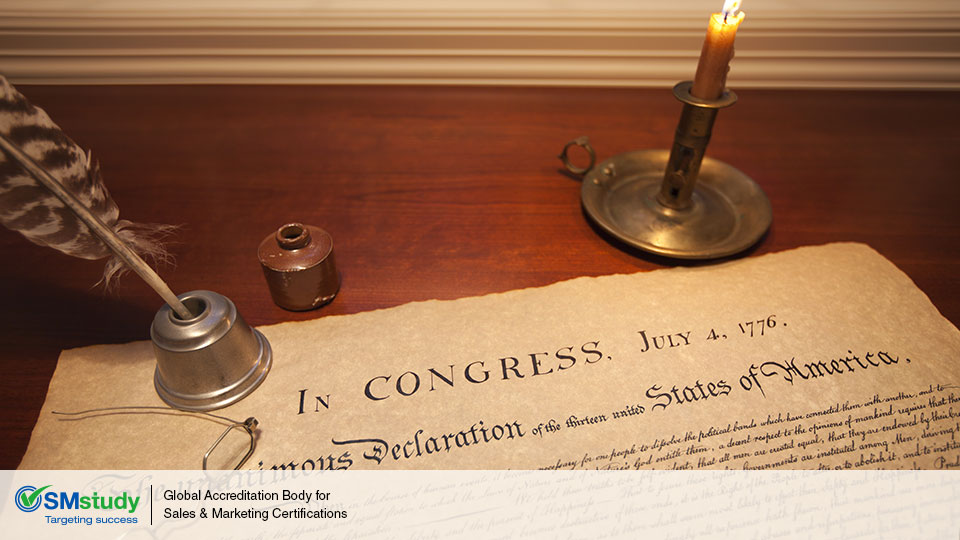
A recent commentary by Merrie Carole Powers in The World Post [1] compared candidate Donald Trump as a brand to America as represented in the Declaration of Independence—arguably the quintessential statement of America the brand.  This got us at SMstudy thinking about America the brand. What does the Declaration tell its citizens and the world about its brand?
A concise definition of branding states that it “is the process of creating a distinct image of a product or range of products in the customer's mind. This image communicates the promise of value the customer will receive from the product or products,” according to the SMstudy® Guide: Marketing Strategy.[2]
So, what distinct image of America comes readily to mind? For many the dominant image is the American Dream. Every presidential candidate mentions the American Dream, and their versions range from the ability to achieve anything through hard work and determination to having a job coupled with raised wages and health for people and their surroundings.[3]
What image springs from the pages of the country’s cry to be itself, to be independent?
In her brand analysis of Trump-the-Brand, Powers used the “unique positioning, clearly defined purpose, truly held values, an authentic personality and a compelling message” elements of a strong brand. Marketing Strategy says that a product’s or service’s value proposition is crucial to its branding. We’ll use several of these to consider Brand America in the Declaration of Independence.[4]
The Declaration’s preamble is well known to many—having had to memorize it at some time during their school days—and it is the place to find the introduction of America’s brand image. In its first sentence the brand begins to take shape unassumingly—almost off-handedly as mere conditions for actions that follow—“it becomes necessary for one people to dissolve the political bands which have connected them with another, and to assume among the powers of the earth, the separate and equal station to which the Laws of Nature and of Nature's God entitle them…”  The Brand claims for itself “the separate and equal station” “among the powers of the earth” “that the Laws of Nature and Nature’s God” says it has the right to. That’s a strong positioning statement, even if it is not unique for countries.
The Brand has a great purpose: to “assume … the separate and equal station,” that is, to step up and take possession of equality among the nations of the entire world.  It is an ennobling purpose. Kouze and Posner said in their work The Leadership Challenge that one of the best practices among successful leaders was the ability to inspire “an ennobling vision of the future.” People want to follow a leader that can do this. And they want to be identified with a brand that does this, too. Perhaps, this is one brand element that explains why so many people emigrate to America.
In Part Two of “Branding America and SMstudy,” we’ll look at Brand America’s compelling message and alluring value proposition.
For more informative and thought-provoking articles on sales and marketing, visit www.SMstudy.com/articles
[1] Powers, Merry Carole. (4/1/16) “Donald Trump vs America: Side-by-Side Brand Analysis.” The World Post. Retrieved on 4/4/16 from http://www.huffingtonpost.com/merry-carole-powers/donald-trump-vs-america-a_b_9592180.html
[2] A Guide to the Sales and Marketing Body of Knowledge, also referred to as the "SMstudy® Guide," is a series of books that provide guidelines for the Sales and Marketing of products and services. It is available at SMstudy.
[3] Ted Cruz says that he and “his entire family have been blessed to live the American Dream — the idea that anyone, through hard work and determination, can achieve anything. And he is committed to ensuring every family has that same opportunity.” For Bernie Sanders, the American Dream includes an “economic agenda that creates jobs, raises wages, protects the environment and provides health care for all.” These quotes come from the respective candidate’s website.
[4] All quotes from the Declaration of Independence come from “the Charters of Freedom” collection of the U.S National Archives at http://www.archives.gov/exhibits/charters/declaration_transcript.html.